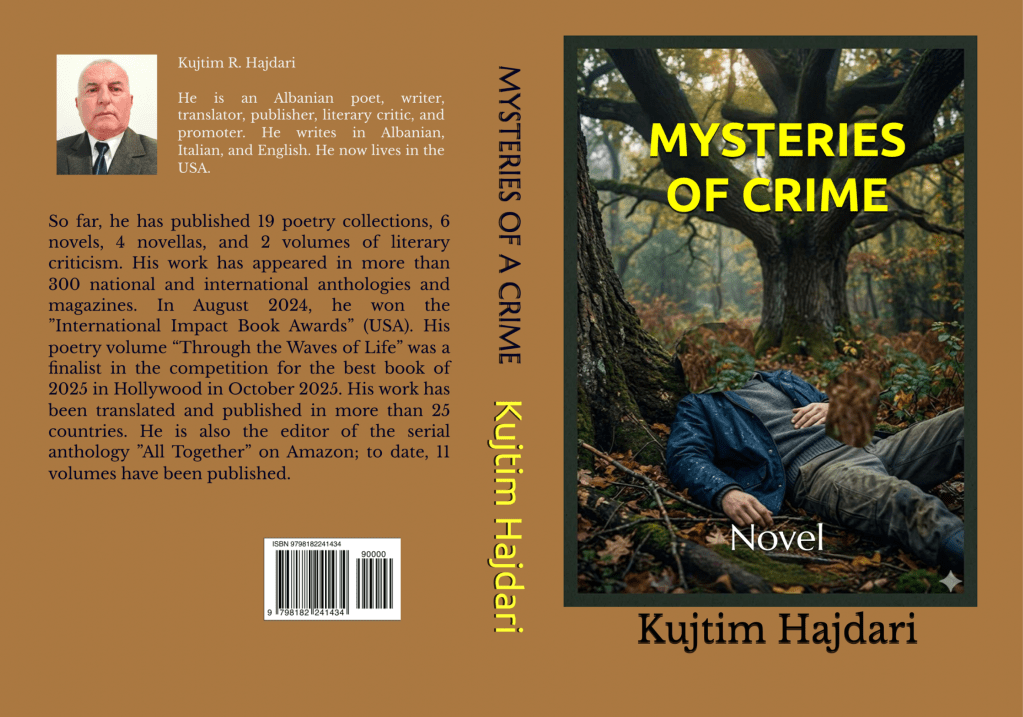
REVIEW OF NOVEL ”MYSTERIES OF A CRIME” BY KUJTIM R. HAJDARI
(Nga Dr. H. Blery)
Kujtim R. Hajdari’s Mysteries of a Crime is much more than a detective novel. Although it is structured around a murder investigation and uses the familiar architecture of suspense, the book quickly reveals itself to be a layered social drama, a psychological study of grief, and a portrait of a community fractured by prejudice, silence, and fear. What begins as a crime story near a lake develops into something deeper and more ambitious: a novel about justice itself and about the distance between legal truth, emotional truth, and the hidden truths children sometimes carry before adults can name them.
One of the novel’s greatest strengths is its atmosphere. From the opening pages, the lake, the fog, the oaks, the rain, and the cold morning air are rendered with a quiet, almost cinematic precision. The setting is not merely decorative; it is symbolic. The lake becomes a repository of secrets, guilt, and unresolved histories. It reflects the town’s outward calm while concealing the violent currents underneath. Hajdari repeatedly returns to the lake as a mirror of the social world around it: apparently still, but in fact full of movement, pressure, and submerged conflict. This gives the novel a unified visual and emotional identity. The reader feels from the beginning that the environment itself is participating in the mystery.
The structure of the book is also notable. The narrative moves between investigation, interrogation, testimony, memory, and observation, building a layered form that slowly broadens the scope of the crime. The novel initially appears to be about Orest’s murder and the suspicion surrounding Albert, but Hajdari refuses to keep the case within the limits of a conventional whodunit. Instead, he uses the investigation as a channel through which to explore a much larger social web: the drug trade, immigrant tension, family grief, institutional pressure, and the way communities manufacture scapegoats. This widening of perspective is one of the book’s most effective achievements. The crime does not remain a single event; it becomes the point where multiple private and public failures converge.
Indrit, the investigator, is a compelling central figure because he is both an agent of the law and a man increasingly burdened by moral uncertainty. He is not written as a cold procedural detective in the standard genre sense. Instead, he is observant, tired, conscientious, and emotionally porous. He notices details others overlook — a tremor in a child’s hand, the shape of a footprint in mud, the wrongness of a silence. But he is also vulnerable to the emotional gravity of the case. His relationship to Ava, and his growing identification with the pain of the families involved, complicate his professional distance. This tension gives the novel emotional depth. Indrit is not heroic in a conventional sense; he is useful because he listens, but he is also unstable because he feels too much. That makes him a persuasive figure for a novel interested in the moral complexity of truth.
Ava is perhaps the novel’s most powerful character. She is introduced as a grieving mother, then gradually revealed as a woman shaped by resentment, survival, love, and irreversible loss. Her emotional trajectory is one of the novel’s most affecting elements. What makes her memorable is not simply her later confession, but the way Hajdari allows her pain to accumulate before it becomes action. The story never reduces her to a single motive. Her grief for Julian, her anger toward Orest, her suspicion of the world, and her exhaustion as a mother all coexist. The result is a character who is tragic without being abstract. When her role in the crime is finally revealed, it feels both shocking and grimly inevitable.
The most striking innovation in the novel may be the role of Rebeka. As a mute child who communicates through gesture and drawing, she becomes the emotional and symbolic center of the story. Her silence is not absence; it is testimony. In many ways, she functions as the book’s conscience, because she sees what adults cannot fully admit. Her drawings — the tree, the rope, the faceless hand, the white scarf — serve as one of the novel’s most original narrative devices. Hajdari uses these images not just as clues, but as a language of trauma. The idea that a child can “speak” through bodily reaction and symbolic drawing is handled with real sensitivity. Rebeka is never treated as a gimmick or a magical child witness; instead, she is portrayed as someone whose body remembers before her words can.
The novel also deserves praise for its social dimension. It presents a small town in which ethnic labels, class resentment, and rumor distort every event. The investigation is never insulated from the social environment. Albert’s status as a foreigner, Ava’s identity as an outsider, Julian’s racialized vulnerability, and the community’s readiness to divide people into “our own” and “the others” all shape the case. Hajdari clearly understands that in such an environment, justice is not only about evidence. It is also about who is believed, who is feared, and who is easiest to blame. That social critique gives the novel urgency.
Stylistically, the prose is vivid and controlled, with a strong sense of visual detail. The author excels at textures: wet mud, cigarette smoke, dim bar light, the sheen of rain on glass, the tension of a courtroom, the stillness of a child’s body. At times, the language leans toward lyrical repetition, especially in descriptions of weather and landscape, but this generally reinforces the novel’s mood rather than weakening it. The recurring images help bind the story together. The lake, rope, tree, fog, and silence all become part of a symbolic system that is easy to recognize and hard to forget.
If there is a limitation, it is that the novel occasionally prefers explanation to restraint. Some passages articulate themes very directly, especially around justice, prejudice, and community guilt. Yet even this tendency reflects the book’s seriousness of purpose. Hajdari is not writing a minimalist crime puzzle; he is writing a moral novel in the form of an investigation. His concern is not only what happened, but what the event reveals about everyone involved.
In the end, Mysteries of a Crime succeeds because it transforms a murder inquiry into a meditation on hidden suffering and the costs of silence. It is a novel about bodies — bodies found, bodies feared, bodies that remember, bodies that accuse. But it is also about the difficulty of making truth visible in a world that prefers convenient stories. By the final pages, the novel has made its deepest claim: that even silence speaks, and that sometimes the most important witness is the one who cannot say a word.
(By Dr. H. Blery)
 all.together.wordpress.com
Leave a comment